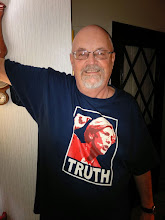
The lead story in this past Tuesday's Bradenton Herald was about the Supervisor of Elections, Mike Bennett's plan to reduce the number of polling places in Manatee County, FL. Bennett, a career politician who was unable to run for re-election to the Florida House due to term limits, was elected to replace the former elections supervisor who was retiring. Bennett, a Republican, is one of the most useless politicians it has been my displeasure have anything to do with--the most useless being Tommy Thompson when he was Governor of Wisconsin. Marching alongside Florida Governor, Rick Scott, he is doing what he can to eliminate voting opportunities for minorities who live in the county.
Unfortunately, the four Republicans on the County Commission voted to accept Bennett's plan while the sole Democrat voted against the plan. Such is the life of a progressive in a blue collar Florida county.
The following is a letter to the editor which appeared in this morning's paper.
Dear Editor:
I was disappointed, but not surprised, upon opening Tuesday's Bradenton Herald to the news that Mike Bennett is planning on closing 30 polling places throughout Manatee County. Walking lockstep with Republicans, both in Tallahassee and Washington, he is working on a plan to disenfranchise voters. Voting is a right, not a priviledge reserved for WASPs like myself.
My dad was a member of the Greatest Generation. I am a Vietnam veteran. Never, in his wildest dreams, did Dad think he was fighting against Hitler and his goal of Aryan supremacy so that minorities could be hindered in that most basic of American freedoms--the freedom to vote for the people of one's choice. I never thought that while enduring the Tet Offensive.
If anything, the number of polling places and opportunities for early voting should be increased, not reduced. To add to the confusion, Bennett wants to renumber the voting precincts. Such a proposal does not streamline anything. It only leads to more confusion and disenfranchisement.
Bennett says he was "quite surprised" at the reaction of others to his proposal. When, Mr. Bennett, was this proposal widely publicized before it was presented to the County Board? If this is the way you want to treat voters--the ones who elected you--then perhaps it will be time for you to look for a new job, come election time.
Dave Hilsheimer
Friday, February 14, 2014

Tuesday, December 17, 2013
The Democracy of Quakerism

The basis of Quakerism, as opposed to other churches is that decisions are made from the bottom up. We have no hierarchy to tell us what to do—no minister, head priest, or priestess (or Pope!)—just numerous Quaker meetings made up of like-minded individuals who make the decisions for their particular monthly meeting. Individual, or “monthly”, meetings in a geographic region are all part of a yearly meeting; the various yearly meetings make up one of the two national organizations—Friends United Meeting (FUM), the evangelical, or conservative, branch of U.S. Quakerism; and Friends General Conference (FGC), the un-programmed, or liberal, branch. Some yearly meetings are members of both national organizations.
The decisions or “leadings” that bear fruit in the monthly can spread to the yearly meeting and, possibly, to one of the two national organizations. A prime example of this is when the youth of the Sarasota Friends Meeting (my home meeting) became involved with the Coalition of Immokalee Workers (CIW), an organization of migrant workers in South Florida that is working for better pay and working conditions for their workers. Our youth took their message and activism to the annual gathering of Southeastern Yearly Meeting. The youth of SEYM became quite active and involved in the plight of the migrant workers and spread the word to the youth of FGC, through the annual gathering this past summer in Colorado. As a result, that sense of activism has sprouted roots in other areas of the country—thanks in large part to the young ones in our own monthly meeting.
Un-programmed Quakers operate with a sense that God (Divine Spirit; Friendly Presence; or however one defines their sense of a higher spirit) is present within us all. We believe we have a direct connection with that spirit and that we need no intermediary to tell us what God wants us to do. It is that sense of continuing revelation that guides us, not only in meetings for worship and business, but in our daily lives, as well.
There is no “majority rule” or leaving any decision up to a single person. It is a total and complete meeting of the minds on how to proceed on any particular issue. Each person brings their bit of Light to the matter being discussed in much the same way as several spotlight beams come together on the stage to make them one where they intersect. This is known in Quakerism as “sense of the meeting”, as opposed to the secular term of “consensus”. To me, sense of the meeting also means that God has a voice in the decision-making process.
Conversely, if one of the light beams does not intersect with the others and illuminates a separate spot on the stage, there can be no convergence of all the light being cast on that stage. As is Quaker practice, if one person has an objection to a particular feeling or direction in which the meeting for business is headed, they can voice their reservations and not allow a sense of the meeting to prevail. A good example of this happened in the Sarasota Friends Meeting many years ago. When it began, the meeting was a nomadic one, gathering in several places for worship throughout Sarasota over the years. A group within the meeting felt it was time to build their own meetinghouse and the idea spread. A building fund was established and started to grow. However, there was one member who felt it frivolous to spend money on the construction of a meetinghouse until, at long last, he finally came around. The proverbial straw that broke the camel’s back was when the meeting was asked to vacate their regular worship space in one of the old Ringling brothers’ mansions (now a part of New College of Florida). The recently installed college president wanted it for his office. The surprising comment to the other members was, “We need a meetinghouse!” Thus, the “weighty” Friend’s Light merged with that of the others and the present meetinghouse was built in 2001. Although it took over twenty years, sense of the meeting was finally achieved.
One way a person who’s Light is not in sync with the others in a Quaker meeting for business, but does not wish to stand in the way of a particular decision or action, is to “stand aside” and let the rest of those in the meeting agree to carry out the decision. In the minutes of the business meeting’s proceedings, the person can either remain anonymous or be recorded as standing aside.
The democracy of Quakerism is a singular example of people working together to reach a common goal. Each member of any particular meeting has an equal voice in the decision making process. We have been referred to, over the years, as a “peculiar people”—ones who operate under the principles of divine guidance and sense of the meeting. We have no need for intermediaries; we feel that compromise is not the giving in of one’s conscience but the seeking out of divine will; we believe that all persons’ thoughts and utterances on a particular subject should be given equal value.
Yes, we are peculiar people, but I wouldn’t trade the Quakers’ way of conducting themselves or their decision-making process for anything else.
Sunday, December 8, 2013
Reflections on Nelson Mandela

During silent worship this morning at the Sarasota Friends Meeting (Quakers), one member stood and gave a message about what a loss it was to mankind that the voice of Nelson Mandela had, at long last, been silenced. That got me to thinking about Mandela and his message.
While he started out as a non-violent opponent of apartheid who advocated civil disobedience as a member of the African National Conference (ANC), he came to believe that armed insurrection was the only way to achieve change. He was ultimately sentenced to life imprisonment in 1963 for his actions. In 1985 he was offered his release from prison by South African President P.W. Botha, an offer Mandela flatly refused. When Botha suffered a stroke and was replaced by F.W. deKlerk, discussions geared toward his release from prison progressed and Mandela was released on February 11, 1990. I recall watching his release in the middle of the night with my wife, Pam. We were both so happy to be witnessing such an historic event. Upon his release from prison, Mandela renounced violence and set the stage for a most wonderful final almost 24 years of his life.
In reflecting on him during worship this morning, it struck me that he was the Abraham Lincoln; the Mohandas Gandhi; and the Martin Luther King, Jr. of South Africa. The only difference was he was able to live out his natural life rather than having been assassinated. South Africa, much like the American South, was a very divided society--a society in which the native African people were subjugated to third class citizens and were looked on by the whites as being akin to something they would wipe off their shoes, had they the misfortune of stepping in an unpleasant deposit on the sidewalk. Mandela and deKlerk were jointly awarded the 1993 Nobel Peace Prize for their work in dismantling apartheid and in 1994 Mandela was elected the country's first black president. His work in transitioning his country from white minority rule to that of the black majority left his mark on South Africa. He remained active after retiring from the presidency in 1999, raising money for various needed projects, building schools and furthering the educational opportunities for his nation as well as promoting nonviolence as the means to an end.
His dedication to non-violence is and will remain his legacy. The world has seen very few people who can affect not only their country but the entire world. He was such an inspiration to so many people. A good friend wrote to me about her thoughts on his passing: "I think we all have it in us to approach life from a place of love and compassion. We all have it in us to put ourselves on the line in the name of justice, real justice for all, to speak up and out. We may not all have the charisma or the desire to be on the front page, but we can and MUST be like Nelson Mandela, the Dalai Lama, Desmond Tutu... I feel like I spent the 8 years under Bush/Cheney saying, 'Where are the leaders?' WE are the leaders, we have to be!! And we have to be the monkey wrenches that stop the wheels from turning, when that is called for."
My prayer is that we all take a bit from Nelson Mandela's lessons and use them to make a better world for all and especially, our children.
Saturday, November 16, 2013
Because of Winn-Dixie
I am a regular at the nearby Winn-Dixie supermarket and much prefer it over the other big Florida chain, Publix. This morning, I stopped there to pick up some meat for dinner. Upon entering the store I was met with a toy display of dolls, cars, trucks, and half size M16s. I was immediately turned off by the display because it appears W-D is endorsing gun use by offering up toy assault rifles, advertised as "machine guns", as an appropriate "toy" for a youngster.
As I was checking out I asked the cashier to let her management know of my concern that these are inappropriate items to be marketed for children. A man, who overheard me tell the cashier I felt it was "disgusting" hollered at me, "Why? Are you anti-gun?" to which I replied I was and that our children are exposed to too much violence as it is.
Upon returning home, I sent the following to Winn-Dixie via their customer comment page on their website:
I am a regular shopper at store #656 and really enjoy the selection and prices Winn Dixie offers as well s the Fuel Perks card. This morning, however, I was quite put off by one of the products you are offering for sale--namely a toy machine gun in the toy kiosk near the front entrance.
We have more than enough violence in our society and our youngsters are exposed to much more than they should be. Don't get me wrong. I grew up in the 1950s and played G.I. Joe and cowboys and Indians with my buddies. The most violence I recall was seeing the Lone Ranger shoot a gun from an outlaw's hand. I had no video games to play. Nowadays, though, there is massive violence portrayed on TV and the movies; uber-violent video games; and mass shootings--from Columbine, through VA Tech, to Newtown, to the D.C Navy Yard, and beyond.
As a person who has seen war firsthand in Vietnam and who is saddened at the daily violence I see on the news and in the local newspapers, I feel your fine company is sending the wrong message by offering these violence-based "toys" for sale in your stores. Winn Dixie is much better than that.
Thank you for your consideration of my concern. I will remain a loyal customer.
Hopefully they'll hear and act on my concern.
As I was checking out I asked the cashier to let her management know of my concern that these are inappropriate items to be marketed for children. A man, who overheard me tell the cashier I felt it was "disgusting" hollered at me, "Why? Are you anti-gun?" to which I replied I was and that our children are exposed to too much violence as it is.
Upon returning home, I sent the following to Winn-Dixie via their customer comment page on their website:
I am a regular shopper at store #656 and really enjoy the selection and prices Winn Dixie offers as well s the Fuel Perks card. This morning, however, I was quite put off by one of the products you are offering for sale--namely a toy machine gun in the toy kiosk near the front entrance.
We have more than enough violence in our society and our youngsters are exposed to much more than they should be. Don't get me wrong. I grew up in the 1950s and played G.I. Joe and cowboys and Indians with my buddies. The most violence I recall was seeing the Lone Ranger shoot a gun from an outlaw's hand. I had no video games to play. Nowadays, though, there is massive violence portrayed on TV and the movies; uber-violent video games; and mass shootings--from Columbine, through VA Tech, to Newtown, to the D.C Navy Yard, and beyond.
As a person who has seen war firsthand in Vietnam and who is saddened at the daily violence I see on the news and in the local newspapers, I feel your fine company is sending the wrong message by offering these violence-based "toys" for sale in your stores. Winn Dixie is much better than that.
Thank you for your consideration of my concern. I will remain a loyal customer.
Hopefully they'll hear and act on my concern.
Thursday, August 15, 2013
Take Me Out to the Ballgame
 I almost got involved in a soap opera at this evening's game
between the Bradenton Marauders and the Palm Beach Cardinals. It was Cancer Awareness Night and pink
Marauders jerseys were up for auction. I
was bidding on Willy Garcia's jersey for Debbie L., his future mother-in-law,
who lives in Beardstown, IL. I had placed in
a bid of $200 for her and, as the bidding was about to close, I went to check
on her bid. A friend of mine, Mike S., put
up a $230 bid, so I upped the bid to $240.
A mutual friend, Keith, asked me what I was doing and I said I was
bidding for Garcia’s future mother-in-law.
Keith got really incensed, telling me Garcia was not engaged to anyone—that
he had a girlfriend he is living with here in Bradenton.
I almost got involved in a soap opera at this evening's game
between the Bradenton Marauders and the Palm Beach Cardinals. It was Cancer Awareness Night and pink
Marauders jerseys were up for auction. I
was bidding on Willy Garcia's jersey for Debbie L., his future mother-in-law,
who lives in Beardstown, IL. I had placed in
a bid of $200 for her and, as the bidding was about to close, I went to check
on her bid. A friend of mine, Mike S., put
up a $230 bid, so I upped the bid to $240.
A mutual friend, Keith, asked me what I was doing and I said I was
bidding for Garcia’s future mother-in-law.
Keith got really incensed, telling me Garcia was not engaged to anyone—that
he had a girlfriend he is living with here in Bradenton.
He then went over and told Mike what I had said. Apparently the “girlfriend” was hovering near
him and heard what Keith told Mike.
Perhaps she was in the group with Mike, Keith and their wives—I don’t
know. Anyway, Keith comes over to me, a
bit pissed off telling me the “girlfriend” was in tears and that there was no
one else in the picture. He told me I
had to come over and let her tell me the situation, to which I replied I was
not going to get into Garcia’s domestic affairs and to please don’t kill the
messenger. I then called Debbie to tell
her she had the winning bid.
A little bit later, I called Debbie and asked her what her
daughter’s name was (Robin) and was she down here, living with Garcia. She said no, that Robin lives in
Pennsylvania. She asked why I was
inquiring and I told her there apparently is a situation down here involving
Willy and another girl. She asked me if
the girl has long dark hair and is a bit on the chunky side, which I confirmed. She told me the girl’s name is Heather and
that she is a “cleat-chaser”. Apparently
Debbie and Robin had a confrontation with Heather when they were down here in
June (when I first met Debbie). In the
meantime I could see Heather sitting, rather stoically, over near the Marauders
dugout, apparently stunned over the entire episode. Garcia hit a double and all Heather could do
was sit there with her arms crossed and had no reaction whatsoever.
While I didn’t feel I owed Keith an explanation, I told
another mutual friend, Pat, that if he wanted to relay the truth to Keith, he
could feel free to do so. He did and
reported back to me that Keith was a bit taken aback by the situation. No doubt Willy is in deep doo-doo this
evening. If so, that’s his problem. One might say he made his own bed and now has
to sleep in it (if not on the couch).
Monday, August 5, 2013
Archie...

Archie, a foundling Shih Tzu, came into Pam's and my life in November 2007. Both she and I are quite interested in fostering and adopting special needs dogs. Archie, although he was not a special needs doggy until the past few months, became a very special pet to the two of us.
We were helping out at Canine Christmas, an annual event involving various dog rescue groups that is held each November here in Bradenton. While she was assisting the South Florida Shih Tzu Rescue, I was working at the snack bar and hardly saw her for a few hours. As things were winding down and the snack bar was cleaned up, I headed over to help Pam and her friend, Dianne, load up Dianne's car. Sitting nearby was a decrepit looking black and white Shih Tzu. Pam asked me if we could pleeeeease take him home. He had been brought by Underdog Rescue, which was located next to Dianne's shih tzu rescue. To me it was love at first sight, and I replied yes. Pam was thrilled at my agreeing to adopt him, as I had declined to adopt other dogs in the past.
We brought him home and started to care for him. He had an eye inflamation at the time and, after taking him to our vet (and neighbor), Mary Smart, she referred him to an veterinary opthamologist who, as it turned out, studied under a very good friend of mine, Dick Dubielzig, at the University of Wisconsin School of Veterinary Medicine. He underwent several treatments but whipped the infection and kept his sight. He was such a joy to have as a part of our lives.
He was so laid back--in fact, the most laid back--dog we have ever had. He took things one day at a time, never snapped at or bit anyone or any other of five the dogs we also care for. He only barked when he wanted to get up on the bed and, occasionally, when he needed to go O-U-T to take care of business. Usually, he'd either walk into the great room and park himself in front of me or would just go to the front door and let out a muted "woof!". Archie was pretty good about going for walks in the morning but, over the past year, they became few and far between. Finally the walks ended and he would only go so far as the yard.
Pam and I have had many pets throughout our marriage, but none compare to Archie. I have often noted to folks that Archie was "...the neatest dog we've ever had". I truly mean that. Chloe is the friendliest--one who has never met a stranger--but Archie was in a class by himself. He'd snuggle when he needed to, but the most favorite thing to do was get laid out on a body pillow at the end of the bed. He claimed ownership of it when were visiting our best friend, Linda, in Miami a few years ago. Linda had it on the guest bed and Archie got comfortable on it and refused to get off it. Gracious as Linda was, she insisted we bring it home for him to lay on. He and the other dogs loved laying on it so much, that I had to lay in a second one a couple years ago--the second one for the great room, where he spent much of his time. Right now, one of our other foundlings, Bella, is curled up on top of it.
R.I.P. Archie. You were a wonderful companion and we know you'll be waiting for us at the Rainbow Bridge when our times come.
Friday, August 2, 2013
Opposition email re: Long Bar Pointe
Local developers are wanting to build a large, hoity toity waterfront project along one of the last remaining wild areas along the shore of Sarasota Bay here in Bradenton. In fact, it is one of the few mangroves and breeding areas left along the west coast of Florida. Being unable to attend a public hearing on Tuesday, next (Aug 6th), I send the following email to my own County Commissioner, John Chappie, as well as the two at-large commissioners. Chappie called me upon receipt of the email, telling me it went to all commissioners and is now a part of the public record. Thankfully, he is opposed to the development. I am pleased to share it with my family, friends, and followers:
Dear Commissioner Chappie:
I am writing you since I won't be able to attend Tuesday's county commission meeting in Palmetto, due to a doctor's appointment. I wish to express my feelings on the proposed amendment to the Comprehensive Plan, an amendment submitted by the developers of Long Bar Pointe, that will forever destroy one of the last remaining natural, undeveloped areas along the south Florida Gulf coast—all for a mega-sprawl complex that no one wants, but the developers.
Long Bar Pointe provides refugee for countless manatees, dolphins, seahorses, fish, and other species, as well as providing breeding and nursery areas for smaller fish. Not only will such a development destroy this area, it will also have an adverse economic effect on those who depend on the Gulf for their livelihoods—commercial fishermen; charter boatmen; and just about anyone who depends on the tourist industry. If there is no sea life to support these businesses the historic way of life, especially in Cortez, will be gone forever. Even beyond the economic matters, environmental concerns such as flooding, wind breaks, natural water filtration, and protection against aquifer depletion must also be considered. With such a major development, these factors must also be addressed by many more people than Carlos Beruff or Larry Lieberman.
Long Bar Pointe provides refugee for countless manatees, dolphins, seahorses, fish, and other species, as well as providing breeding and nursery areas for smaller fish. Not only will such a development destroy this area, it will also have an adverse economic effect on those who depend on the Gulf for their livelihoods—commercial fishermen; charter boatmen; and just about anyone who depends on the tourist industry. If there is no sea life to support these businesses the historic way of life, especially in Cortez, will be gone forever. Even beyond the economic matters, environmental concerns such as flooding, wind breaks, natural water filtration, and protection against aquifer depletion must also be considered. With such a major development, these factors must also be addressed by many more people than Carlos Beruff or Larry Lieberman.
For these reasons, I plead with you to reject this self-serving amendment that benefits no one but Messrs. Beruff and Lieberman.
Sincerely,
David P. Hilsheimer
Subscribe to:
Posts (Atom)